If you've ever stood in front of the fridge at 2 a.m. holding a bottle and wondering, "Is this still okay?"… you are not alone. This is one of the most common questions I get from families in my Tempe and Chandler offices.
The good news? Breast milk is pretty tough stuff. It has its own germ-fighting cells, so it stays fresh longer than most people think. But the rules can feel confusing, especially when you hear different numbers from your hospital, your pump company, and your friends.
Let's clear it up. I'll walk you through:
What the CDC says
The safest approach for preemies and babies with health conditions
What's realistic for everyday life with a healthy, full-term baby
As always: feed the baby. No guilt, no pressure.
What the CDC says about breast milk storage
The CDC (Centers for Disease Control and Prevention) bases its guidelines on research from the Academy of Breastfeeding Medicine. These rules are for healthy, full-term babies.
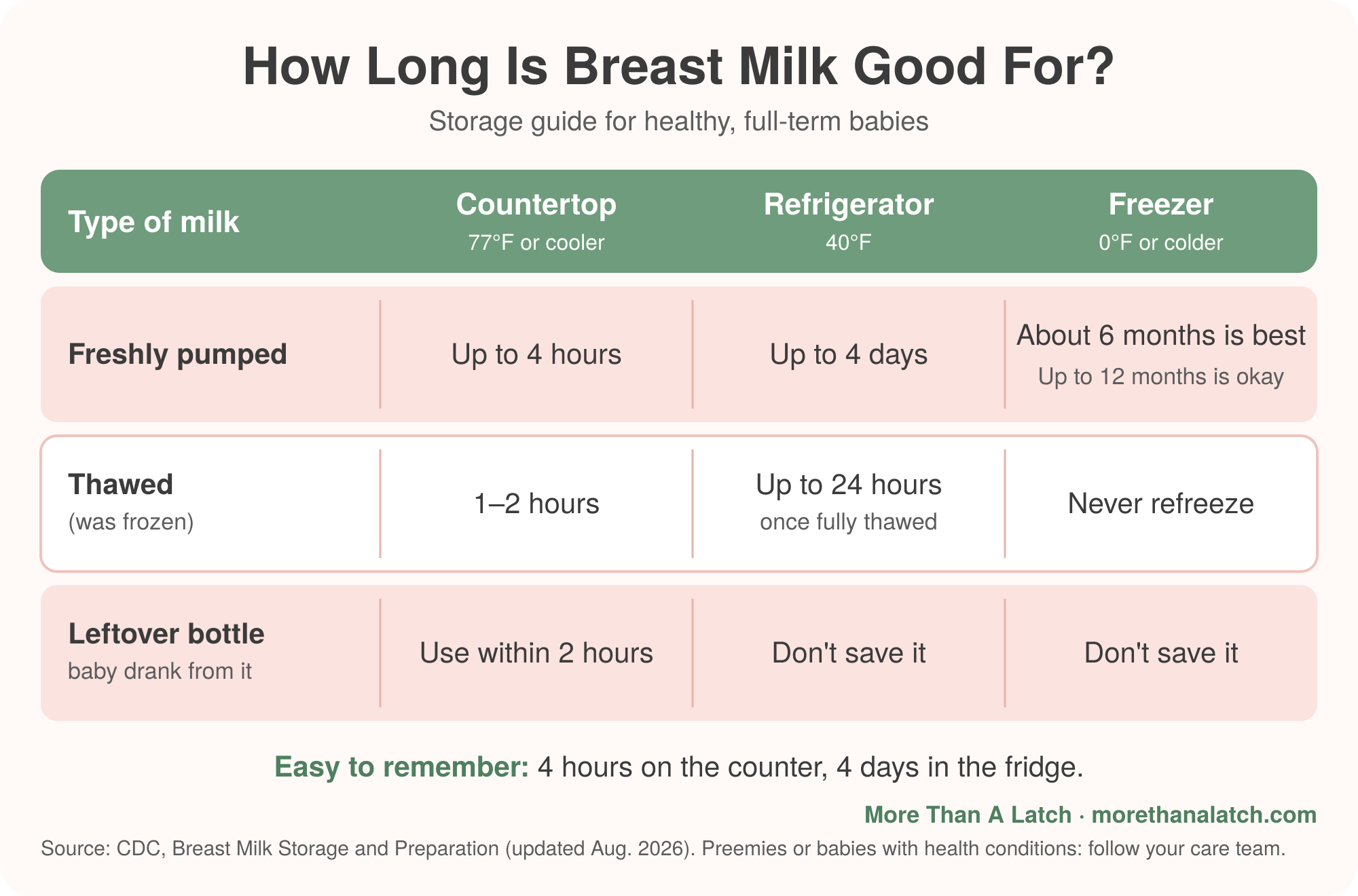
An easy way to remember it: the "Rule of 4s." That's 4 hours on the counter and 4 days in the fridge.
A few more CDC tips:
Label every bag or bottle with the date you pumped it.
Store milk in the back of the fridge or freezer, not in the door. The door warms up every time you open it.
Store small amounts, about 2 to 4 ounces, so less milk goes to waste.
Cooler bag: Milk can stay in an insulated cooler with frozen ice packs for up to 24 hours. When you get where you're going, use it, refrigerate it, or freeze it.
Thawed milk in the fridge: Start the 24-hour clock when the milk is fully thawed, not when you took it out of the freezer.
The safest approach: preemies, NICU babies, and babies with health conditions
Some babies need extra care. This includes babies who:
Were born early (preterm)
Are in the NICU or were recently in the hospital
Have a weak immune system (immunocompromised)
Have a serious medical condition
These babies can get sick from germs more easily. So their milk rules are stricter. The CDC's home guidelines are not written for them.
Many hospitals use rules like these for fragile babies:
Refrigerate milk right away. Avoid leaving it out on the counter.
Use fridge milk sooner, often within about 48 hours. If you won't use it by then, freeze it.
Be extra careful with cleaning. Wash your hands before pumping, and clean and fully dry pump parts after every use.
Use fresh milk first when you can. Fresh milk has the most active immune cells.
Most important: If your baby has a health condition, follow your baby's care team. Your NICU or pediatrician may give you rules that fit your baby. Their guidance comes first.
What's realistic for everyday life
Now let's talk about real life with a healthy, full-term baby. You're tired. You're juggling a lot. You might be pumping at work, at daycare drop-off, or in your car.
Here's what I want you to know:
The CDC numbers are the "best" numbers, not a cliff. The Academy of Breastfeeding Medicine, a group of doctors who study breastfeeding, says:
Counter: 4 hours is best. Up to 6 to 8 hours can be okay if the milk was pumped very cleanly and the room is cool.
Fridge: 4 days is best. Up to 5 to 8 days can be okay if the milk was pumped very cleanly.
Freezer: About 6 months is best. Up to 12 months is okay.
So if you find milk in the fridge on day 5, it's not an automatic emergency. Milk pumped with clean hands and clean parts, and kept cold in the back of the fridge, is usually still fine.
When I'd play it safe and toss the milk:
It smells sour or rotten (like spoiled cow's milk)
It sat out in a hot room, car, or backyard
Your baby is sick, preterm, or has a health condition
You aren't sure how long it's been sitting out
A note for my Arizona families: The CDC's "room temperature" means 77°F or cooler. In Phoenix, Tempe, and Chandler, our cars, garages, and patios can be way hotter than that, even in fall. If you're out and about, keep milk in a cooler bag with ice packs. Don't count on the "4 hours on the counter" rule in the heat.
Does your milk smell soapy or metallic after freezing? Some people have milk with high lipase, a natural enzyme that breaks down fat. It can change the smell or taste. It's usually safe for baby. But if your baby refuses it, I can help you troubleshoot.
Thawing and warming: quick tips
Thaw milk in the fridge overnight, in a bowl of warm water, or under lukewarm running water.
Never use the microwave. It can create hot spots that burn baby's mouth, and it can damage the good stuff in your milk.
Warming is optional. Many babies will drink cold or room-temperature milk just fine.
Swirl or shake to mix the fat back in. Either one is fine. Shaking won't hurt your milk.
Test a few drops on your wrist. It should feel warm, not hot.
Once baby starts drinking from a bottle, use the rest within 2 hours, then toss it. This is the CDC's current guidance (page updated August 2026). You may have heard "1 hour" before. That comes from the Academy of Breastfeeding Medicine's range of 1 to 2 hours, so 1 hour is just the more cautious end. Source: CDC, Breast Milk Storage and Preparation.
When to get extra help
Milk storage is often part of a bigger picture. Maybe you're going back to work, building a freezer stash, or your baby is suddenly refusing the bottle. These are all things I help families with every week.
I'm Kylie, a registered dietitian (RDN) and board-certified lactation consultant (IBCLC). You can read more about me and my "why" here.
I see families in person at my Tempe office and my Chandler office. Many visits are covered by insurance. You can check your insurance coverage here.
Ready for a plan that fits your life? Book your visit here, or text or call me at 480-788-7709.
Feed the baby. No guilt, no pressure. 💗
This post is for general education. It isn't medical advice for your baby. If your baby was born early or has a health condition, talk with your baby's doctor or care team.
Sources
Centers for Disease Control and Prevention (CDC). Breast Milk Storage and Preparation.
Eglash A, Simon L, and the Academy of Breastfeeding Medicine. ABM Clinical Protocol #8: Human Milk Storage Information for Home Use for Full-Term Infants, Revised 2017. Breastfeeding Medicine. 2017;12(7):390–395.
American Academy of Pediatrics, HealthyChildren.org. Storing and Preparing Expressed Breast Milk.